From Fear to Confidence: My Development as a Writer
In reflecting on the recent semester, I learned to enjoy free writing. I was scared at the beginning of my composition class, as I recently moved to the USA and everything looked challenging and overwhelming. After joining college, I was nervous about using my English language skills in every aspect of my life, both inside and outside of the classroom as a freshman. From my childhood, I learned reading and writing in English, but it was completely different from what I had learned the past few years. I used to memorize most of my lessons to do better in every subject and for that free writing and thinking seemed very cumbersome to me. Being creative seemed very challenging to me, but I worked on my writing and thinking skills. Over my recent academic journey, I worked on overcoming the challenges of becoming a free thinker and writer by improving my writing skills and creative thinking through using effective strategies.
When the composition class began, I was unsure about my free writing and what to expect. I realized that college level writing would challenge my old writing level and push me to grow. My composition class was focused on language and literacy, and students were asked to write essays highlighting the main theme. Through this course, I learned about the diversity of languages in the United States and gained a deeper understanding of the actual meaning of literacy. The course was divided into two classes, the first class was a discussion-based class about different topics related to language and literacy, and the second was a writing class where I learned strategies for free writing.
Before we began writing, the professor of this course went through the topics we would be writing about. At first, students were required to read a small textbook to gather knowledge about the basics of reading and writing strategies before applying them in their own work. One of the valuable skills I gained was the ability of analyzing texts and exploring them thoroughly. It’s really an important exercise before starting writing. Through reading and discussing different genres—such as personal narratives, argumentative essays, and reflective pieces—I learned how genre influences the structure and style of writing. Understanding genre helped me make more free choices in my own essays. Through class discussions, I learned that understanding the rhetorical situation is crucial to effective writing. Considering the audience and purpose helped me choose the right tone, structure, and level of detail in my essays. For example, when writing a personal narrative, I focused on emotional connection. From my final draft of the narrative essay, “ “Why can’t you understand a simple topic, you are not giving your best at all!” she said to me one day when I asked for resolution on a coding assignment. Those words made me feel so vulnerable. My confidence crashed, and my anxiety spread to other subjects as well”. For a research essay, I concentrated more on logical evidence and persuasive techniques, an example, “ AI becomes an attractive option. However, while saving money is important, it’s also essential to remember that the cheapest or fastest solution is not always the best, especially in situations where accuracy, clarity, and patient safety are involved.”
Throughout the course, I developed several important strategies that strengthened my reading, writing, and revising processes. When approaching reading assignments, I learned to preview texts, annotate key points, and ask critical questions to better understand the author’s purpose and main arguments. For writing, brainstorming and freewriting techniques helped me generate ideas without the fear of making mistakes, while outlining provided a clear structure for my essays. During the drafting stage, I focused on expressing my ideas fully without worrying about grammar or style, understanding that the first draft is meant for exploration. An example from my first draft of the narrative essay, “I wanted to do coding but don’t know how to start”. Collaboration also became an essential part of my learning process; by sharing my drafts with peers and participating in peer review sessions. I gained valuable feedback that helped me focus on my main topic more clearly and avoid unnecessary repetition. For my narrative’s thesis statement, I was so confused at my first draft how to make it logical, but I wrote down so I could work on it later on the second draft and the thesis was, “I went through several challenges to learn coding”. Finally, revising and editing strategies, such as focusing on content first and then polishing grammar and sentence structure, allowed me to refine my work more effectively. “My teacher use to neglect me for asking questions”, this is from my first draft of my narrative essay and after revising it became, “Whenever I struggled to understand a concept, her feedback was neglectful”. Together, these strategies have made me a more thoughtful, organized, and confident writer.

In addition to classroom learning, I developed strategies to understand and use both print and digital technologies to support my writing. Textbooks and handouts, provided foundational knowledge about reading and writing techniques. However, digital resources played a crucial role in expanding my understanding, especially when it came to learning citation styles like MLA format. I often turned to YouTube videos for help, where many instructors explained MLA guidelines in clear, easy-to-follow ways. Watching tutorial videos allowed me to see step-by-step demonstrations on how to format essays correctly, cite sources properly, and create a Works Cited page. These visual examples made complex rules much easier to grasp than simply reading about them. By using a combination of print and digital resources, I was able to build stronger research and citation skills, which greatly improved the academic quality of my writing. As I progressed through the course, I also learned how to locate credible research sources to support my writing. In the beginning, finding reliable information felt overwhelming because there were so many options available online. However, through class discussions and practice, I developed strategies for identifying trustworthy sources such as academic journals, library databases, and scholarly websites. I learned to evaluate sources by checking the author’s credibility, the publication date, and the purpose of the text. Additionally, I used digital platforms like Google Scholar and my college library’s online database to find peer-reviewed articles and research studies. Examples from my research essay, “AI cannot capture the subtleties and cultural nuances of the text like a human translator, even if it works faster and cost-effective (Moneus)” and “Lilia Stoyanov, in the article, “AI vs. Human Translators: Who Will Win the Translation Battle?” highlights the shift by pointing to labor market trends. She notes, “Employers of interpreters and translators are expected to have 20% growth in employment till 2032, according to U.S. Bureau of Labour Statistics”(Lilia).”This process not only strengthened my essays by providing strong evidence but also taught me the importance of using accurate and ethical research practices. Learning how to locate and evaluate research sources has become an essential skill that I will continue to use in future academic work.
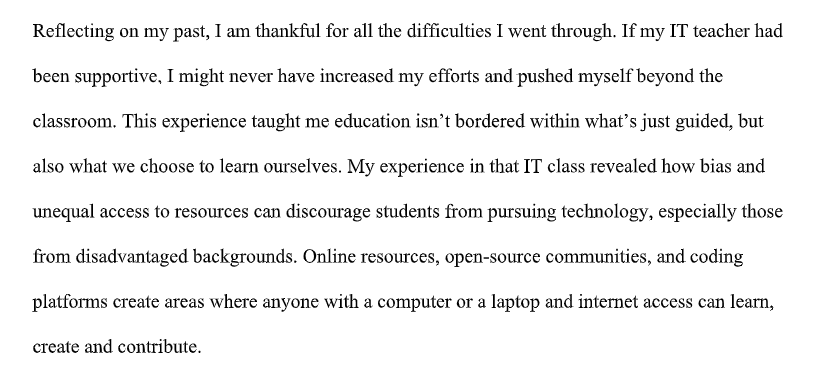
Here is the screenshot from my final narrative essay:
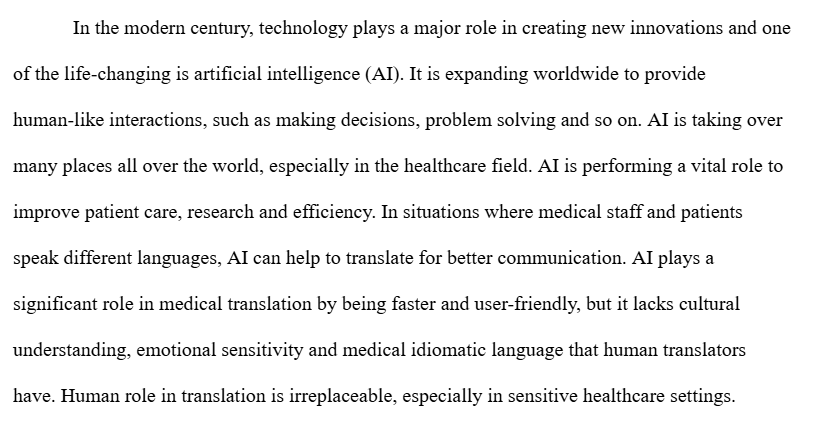
Here is the screenshot from my final researched essay: